
Growing up is not always easy for a young monkey. For baby LEO, the transition away from regular nursing appears to be bringing a difficult and emotional moment. His familiar source of comfort is changing, and his little face reflects the uncertainty that can come with such an important stage of development.
Mom LIBBY remains nearby, watching her youngster as he adjusts. A mother’s care is not always shown through constant feeding or carrying. Sometimes, it can mean allowing a baby to gradually become more independent while staying close enough to provide reassurance.
LEO may not understand why things are changing, but his reactions show how strongly he still depends on his mother. His small movements, expressions, and attempts to stay close make this moment especially touching.
For young monkeys, learning to eat other foods and becoming less dependent on nursing is a natural part of growing. LEO’s journey reminds us that even ordinary moments in a mother and baby’s life can reveal the gentle bond between them.
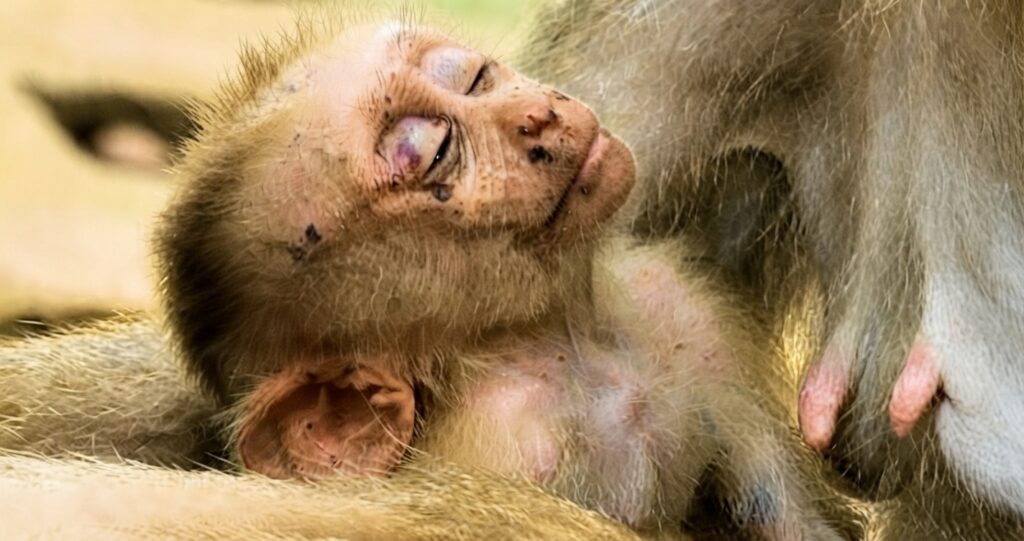
After watching LEO’s behavior, it is easy to notice how much he is still learning. The transition toward greater independence can take time, and a young monkey may continue seeking familiar comfort from his mother even as his needs begin to change.
LIBBY’s presence provides an important sense of security. Rather than viewing the moment as rejection, it can be understood as part of the gradual process of growing up. Mothers and babies communicate through body language, proximity, vocalizations, and everyday interactions, and each encounter can help a youngster learn what comes next.
LEO’s expression may look especially serious, but we should be careful not to assume exactly what he is feeling. What can be observed is a young monkey experiencing a change in his routine and remaining connected to his mother.
Mom LIBBY and baby LEO’s quiet interaction offers a simple glimpse into family life in the troop. Sometimes, growing means moving slowly from complete dependence toward independence, one small step at a time.