
The earliest days of a newborn monkey’s life are filled with small but important moments. Every movement takes effort, every new sensation matters, and staying close to the mother can provide warmth, protection, and the opportunity to nurse. For such a tiny baby, even lifting the head or pushing the body upward can become a determined little effort.
In this scene, the newborn repeatedly tries to get up and move toward the mother, appearing to seek milk. The baby’s movements are delicate and unsteady, reflecting how much support a newborn may need during this early stage of life. Nearby, the mother does not appear to allow nursing during the moments shown. Watching this interaction can leave viewers wondering what is happening and whether the little one will soon have another opportunity to feed.
However, a short video cannot tell us everything about the mother’s behavior or the baby’s condition. A mother may change position, pause, or respond differently at different times, and we cannot determine from this scene alone why nursing does not occur. It would be unfair to conclude that she does not care for her baby based on a brief interaction.
What makes this moment so affecting is the contrast between the newborn’s persistent efforts and the uncertainty of the situation. The baby keeps trying, one small movement at a time. As viewers, we can feel concern for the little one while remembering that careful observation is needed to understand what the mother and baby truly need.
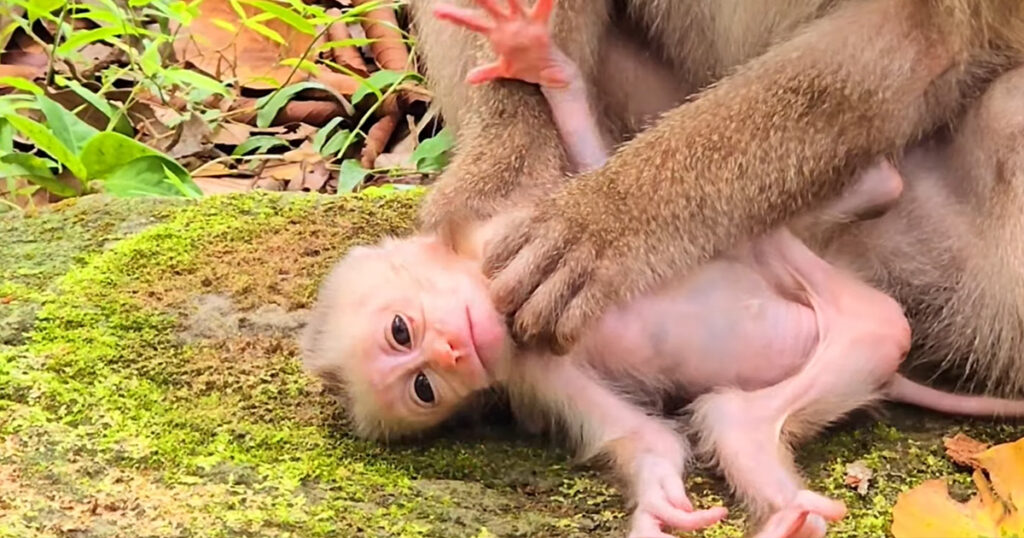
The newborn’s repeated attempts to rise and seek milk make this a moment that is difficult to watch without feeling concerned. The baby appears to keep moving toward the mother, as though searching for a comfortable position to nurse. Yet, during the interaction shown, nursing does not seem to take place.
For a newborn monkey, access to milk is essential. Very young infants depend on their mothers for nourishment and warmth, and they have limited ability to meet their own needs. If a newborn repeatedly attempts to nurse without success, the situation deserves careful attention, especially if the behavior continues or the baby appears weak, cold, unusually quiet, or unable to stay close to the mother.
Still, we should be cautious about interpreting what we see. The video alone does not establish how long the baby has gone without feeding, whether nursing happened before or afterward, or why the mother is not nursing in these moments. Her behavior should not automatically be described as rejection or a lack of maternal love.
In a natural setting, the relationship between a mother and her newborn can involve many subtle movements and changes in position. Understanding the interaction requires looking at the wider context, including whether the baby is eventually able to feed and whether the mother continues to provide appropriate care.
For anyone responsible for the animals, repeated unsuccessful nursing attempts would be a reason to seek guidance from a qualified wildlife veterinarian or experienced primate caregiver. A newborn’s welfare must come first, and any intervention should be guided by people who understand the species and the risks involved.
This tiny baby’s persistence reminds us how vulnerable newborn wildlife can be. We can hope that the little one receives the nourishment and care needed to grow, while respecting the fact that the full story extends beyond the moments captured on camera.